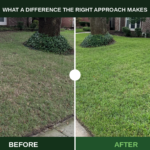
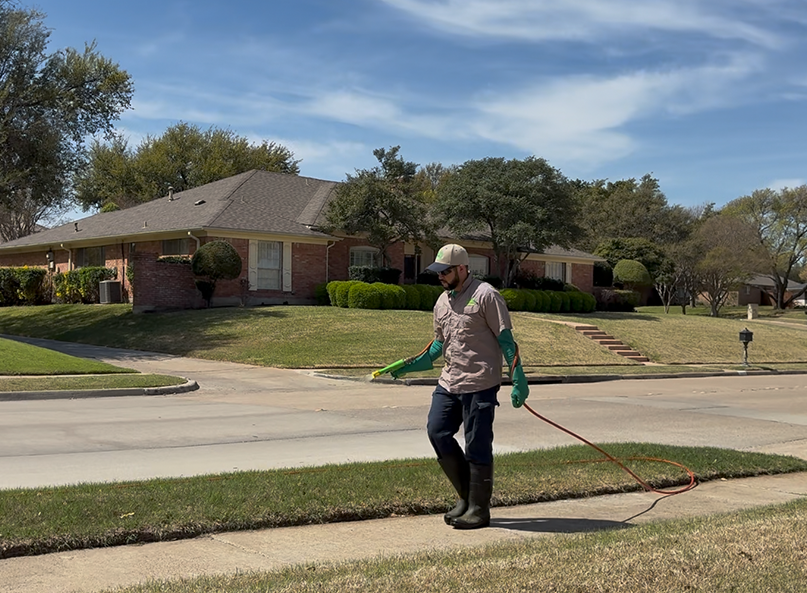
It’s early spring. You’re standing in your driveway looking at a brown lawn while the yard across the street is already a deep, rich green. You’re doing everything right — or at least you were last year. So what’s going on?
After 46 years working with North Texas lawns, we hear this question every spring, almost like clockwork. The good news: in most cases, a brown spring lawn is not a sick lawn. It’s a patient one.
There are three distinct reasons your neighbor’s lawn greens up faster than yours — and understanding them will tell you whether you need to act or simply wait.
Reason 1: Your Neighbor Has a Cool-Season Grass
The most common explanation, especially in established neighborhoods, is that the green lawn next door isn’t the same type of grass as yours.
Cool-season grasses like winter rye and fescue are grown from seed and stay green throughout the winter. They thrive in cooler temperatures and look their best in early spring — right when your Bermuda or St. Augustine is still fully dormant.
Here’s the catch: winter rye dies off in late spring when temperatures climb. Fescue struggles through Texas summers and rarely survives without significant irrigation and replanting. That green lawn you’re envying in March often looks rough by July.
If your lawn has Bermuda or St. Augustine — the two most common warm-season grasses in North Texas — dormancy in late winter and early spring is completely normal. It’s not a sign of poor health. It’s the grass doing exactly what it’s supposed to do.
Reason 2: That Green Lawn Is Actually Full of Weeds
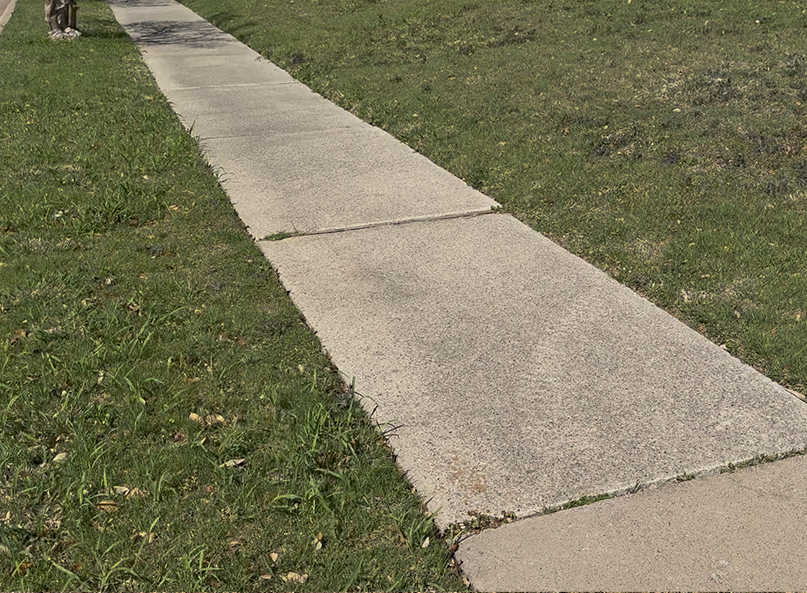
This one surprises people. From the street, a weedy lawn can look lush and green in early spring. But step closer and you’ll see it’s not grass — it’s a collection of cool-season weeds that germinated over the winter.
Henbit, chickweed, annual bluegrass (Poa annua), and other grassy weeds green up early and can make a lawn look healthy when it’s actually in poor shape. Without a proper pre-emergent application in the fall, that winter weed growth has nothing stopping it.
A well-maintained lawn that received pre-emergent treatment last fall may look browner right now — but it’s cleaner. You’re not seeing a problem. You’re seeing the result of doing things correctly.
Reason 3: Soil Temperature and Sun Exposure
This is the one that confuses people the most, especially when the green lawn is directly across the street and they’re both clearly the same type of grass.
Grass doesn’t respond to air temperature — it responds to soil temperature. When the soil warms up enough, the grass comes out of dormancy. The threshold for Bermuda grass is generally around 65°F at a 4-inch depth, sustained over several days.
Here’s where orientation matters. Ken’s own lawn faces north, which means his side of the street stays in shade for most of the day. The lawns across the street get full sun from morning to evening. That sunlight difference translates directly to soil temperature — and a two to three week difference in green-up timing between sunny and shaded lawns is completely normal.
The same principle applies within a single yard. Areas under large trees or on the north side of your home will always be the last to fully come out of dormancy. That’s not a problem — it’s physics.
| ☀️ Sunny lawn faces south or west → soil warms faster → greens up earlier |
| 🌥️ Shaded lawn faces north or sits under trees → soil warms slower → greens up later |
| Typical difference: 2–3 weeks between the earliest and latest lawns on the same street |
What to Expect — and When
For most North Texas homeowners with Bermuda or St. Augustine, here’s the general timeline:
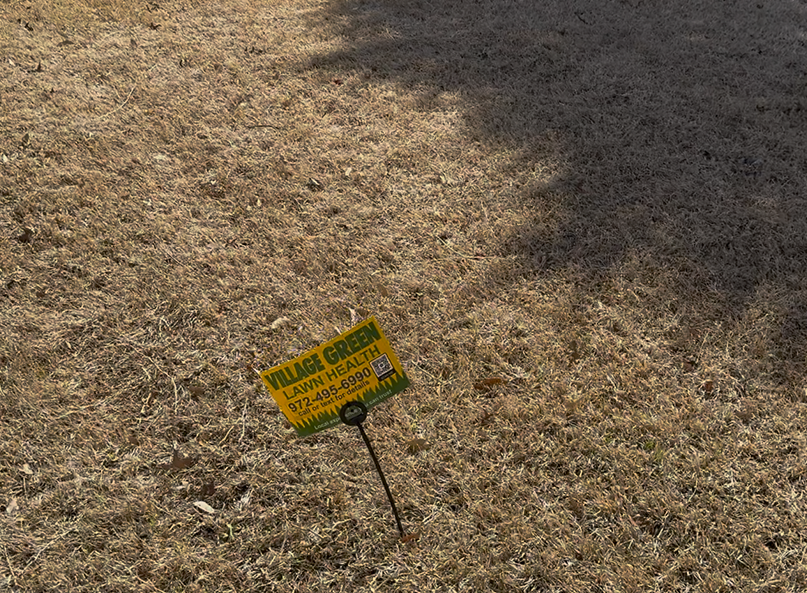
- Late February – March: Lawn is dormant or just beginning to show signs of life. Some green at the soil level, mostly brown on top.
- April: Green-up accelerates as soil temperatures rise consistently. Sunny lawns may be fully green; shaded areas still patchy.
- Early May: Most lawns in the DFW area are back to full color. If yours isn’t by mid-May, that’s worth a closer look.
The short version: if your lawn was healthy at the end of last season, it will be healthy again this season. It just needs warmer soil and a little patience.
When Should You Actually Be Concerned?
Brown in spring is usually normal. But there are situations where it’s worth calling for an assessment:
- Your lawn was showing thinning, bare patches, or disease symptoms before it went dormant last fall
- By mid-May, large sections still haven’t greened up while the surrounding lawn has
- You notice unusual discoloration — gray, black, or rust-colored patches — rather than the tan/beige of normal dormancy
- You had significant grub activity, drought stress, or fungal issues last summer
If any of those apply, a spring lawn assessment can tell you whether you’re looking at a dormancy issue or something that needs treatment.
Ready to Start the Season Right?
Village Green’s Signature Lawn Health Plan covers your lawn from early spring through fall — fertilization, weed control, pre-emergent applications, and the ongoing monitoring that keeps your lawn healthy year after year.
New customers receive 50% off their first visit. No contract required. Every visit is backed by our 90-Day Worry-Free Guarantee.
We’ve been taking care of lawns in Plano, Richardson, McKinney, Frisco, Garland, Sachse, and the surrounding DFW area since 1980. We know how North Texas grass behaves — because we’ve been watching it for over four decades.
→ Learn about the Signature Lawn Health Plan → Contact us to schedule your first visit
About Village Green Lawn and Pest
Village Green is a family-owned lawn care and pest control company based in Plano, Texas. Founded in 1980, we serve homeowners throughout the DFW area with lawn health programs, mosquito control, and pest control — all backed by our 90-Day Worry-Free Guarantee and a no-contract policy. One local company. One point of contact. No 800 numbers.