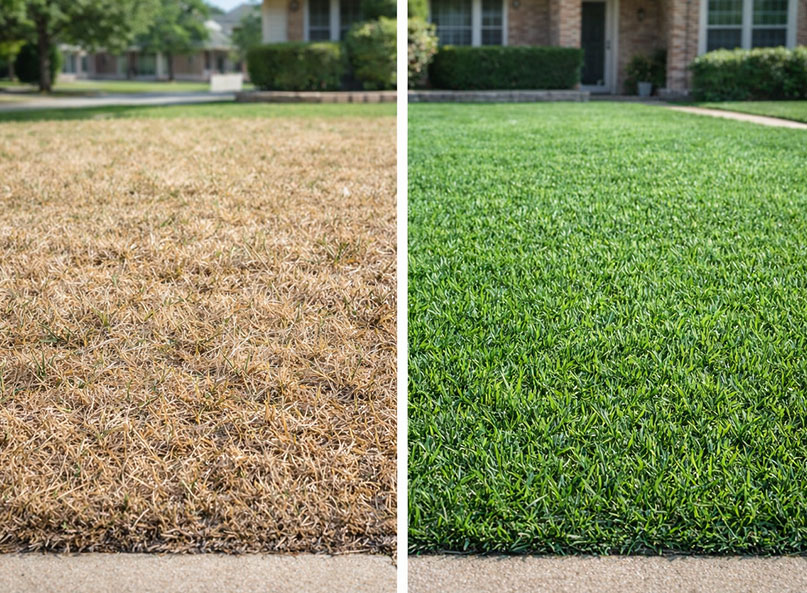
If your lawn is greening up well this spring, keep doing what you’re doing. But if it still looks dull or patchy, there’s a straightforward explanation — and it’s almost always about irrigation timing.
Our technicians are seeing a split across the area right now. Lawns with sprinklers already running are responding normally. Lawns without consistent irrigation are lagging behind — and in certain neighborhoods, the gap is especially noticeable.
What’s happening this spring
The past few springs in North Texas were cool and wet enough that a lot of homeowners could wait until late spring to turn on irrigation and the lawn did just fine. That pattern created a reasonable habit: hold off on sprinklers until May or June.
This spring is warmer and drier than those recent years. The rain in the forecast has mostly not arrived. That combination means lawns that are waiting on irrigation are waiting longer than usual with less natural help from the weather. Bermuda grass needs warmth to break dormancy — that’s happening — but it also needs consistent moisture to actually grow. Without irrigation, warm and dry just means stressed.
Lawns that have been watering regularly are not having this problem.
Why newer neighborhoods like Sachse and Murphy are feeling it more
Not every yard is equal when it comes to spring stress. Our techs have noticed that properties in newer developments — Sachse, Murphy, and similar eastern communities — are showing more visible slow green-up than older, established neighborhoods.
The reason is tree canopy. Newer homes have younger, smaller trees. That means the lawn gets full sun most of the day, which accelerates soil drying. In older neighborhoods like established parts of Plano and Richardson, mature trees provide afternoon shade that helps the soil hold moisture longer.
If you’re in a newer neighborhood without much tree canopy and you haven’t turned on your irrigation yet, your lawn is drying out faster than one in a shadier yard and needs water sooner.

The fix: start irrigating now
This isn’t complicated. Lawns need three things: sun, water, and nutrition. Sun is not a problem this spring. Nutrition is what Village Green provides through scheduled treatments. If your lawn is behind, water is the missing variable.
A reasonable starting point for North Texas Bermuda in current conditions:
- Water 2–3 times per week
- Target roughly ½ to ¾ inch per session
- Water early morning (before 9 AM) to limit evaporation and reduce fungal risk
- Do the footprint test — if footprints stay visible in the turf, the lawn is telling you it’s thirsty
Download our Free Spring Watering Guide
Why this matters for your treatments
Fertilizer is absorbed through root activity, and roots need moisture to function. A dry lawn doesn’t absorb nutrients efficiently. When you keep up with irrigation, the treatments we’re applying have the environment they need to work — and that’s when you see the results you’re paying for.
The partnership is simple: you provide the water, we provide the nutrition, and the lawn gets the result we’re both after.

Bottom line
If your lawn looks good right now, your irrigation timing is probably right. If it’s still slow, turning on your sprinklers this week is the most impactful thing you can do. The treatments are doing their part — water is what closes the gap.
Questions about your specific lawn? Call or text us at 972-495-6990. Or use our chat function on the website (to your left) to ask us a question.
Village Green Lawn and Pest has served North Texas homeowners since 1980. No contracts. 90-Day Worry-Free Guarantee. Serving Plano, Richardson, McKinney, Frisco, Garland, Sachse, Allen, and surrounding areas.