The question most homeowners never think to ask
If you already pay a pest control company, it’s natural to assume your lawn is covered. Ken Hyatt, who has been running Village Green in Plano since 1980, says this assumption is one of the most common — and costly — he sees North Texas homeowners make.
“People often don’t even ask,” Ken explains. “They just assume there’s overlap and skip the lawn insect program entirely.”
Here’s what’s actually happening.
Pest control and lawn insect protection are not the same service
The confusion is understandable. Both involve insects. Both get applied around your property. But the targets, the products, and the purpose are completely different.
| Pest Control | Lawn Insect Protection |
| Keeps insects out of your home | Protects your grass from root and blade damage |
| Treats foundation, doorways, home exterior | Treats the lawn itself |
| Targets: spiders, roaches, indoor ants | Targets: grubs, chinch bugs, lawn-damaging insects |
| Focus: structural pest exclusion | Focus: turf health and survival |
What pest control actually covers
A standard pest control program is designed to keep insects out of your house. Technicians treat your foundation, entry points, and home exterior to create a barrier against spiders, roaches, and ants that try to come inside.
Some pest companies will treat lawn areas for ants — but that’s still focused on keeping ants out of your home, not on protecting your grass.
They are not monitoring your turf for the insects that live in the soil and feed on grass roots.
The insects that actually destroy lawns
In North Texas, two insects cause the most serious lawn damage — and most homeowners have never heard of them until their lawn is already in trouble.
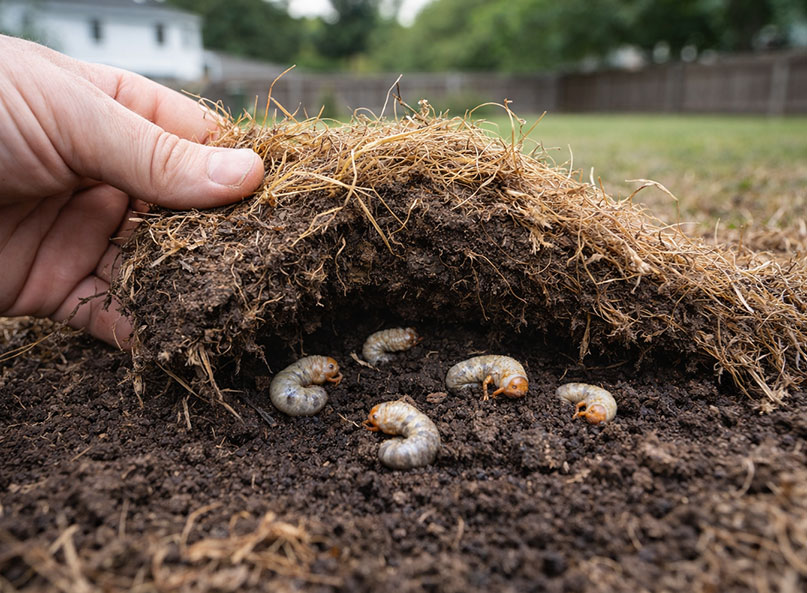
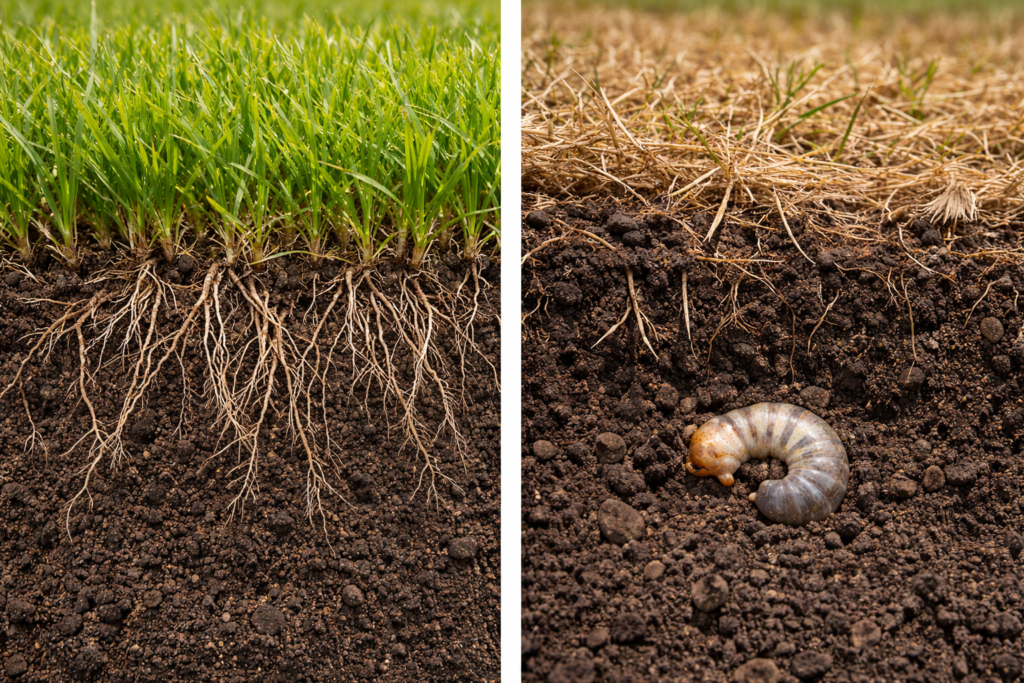
Grubs. Grub worms are beetle larvae that live in your soil and feed on grass roots. Because the damage happens underground, homeowners often don’t notice until large sections of turf can be pulled up like a loose carpet. By then, significant root loss has already occurred.
Chinch bugs. Chinch bugs are a specific and serious threat to St. Augustine grass — one of the most common turf types across Plano, Richardson, McKinney, and Garland. They feed on grass blades and inject a toxin that accelerates die-off. Damage can spread rapidly in hot, dry conditions.
Your pest control company is not treating for either of these. Their program isn’t designed for it.

What Village Green’s Lawn Insect Protection does
Village Green’s lawn insect program targets the insects that specifically damage grass — applied on a schedule that accounts for when these pests are most active in North Texas’s climate.
It’s a separate service from pest control, not a replacement for it. If you already have someone treating your home’s interior and foundation, that’s fine. Keep them. But don’t assume that protection extends to your lawn.
The honest answer
Village Green offers both pest control and lawn insect protection. Ken’s straightforward take: if someone else is already handling your home’s pest exclusion, there’s no reason to switch — just make sure your lawn is separately protected.
The healthy lawn you want requires protection from the insects that target grass specifically. That’s a different job, and it needs a different program.
Village Green Lawn and Pest
Serving North Texas since 1980 — Plano, Richardson, McKinney, Frisco, Garland, Sachse, Allen
No contracts. 90-Day Worry-Free Guarantee. 972-495-6990