You’ve heard the term “drought stress.” But standing in your yard, how do you actually know that’s what you’re looking at — versus disease, pests, or something else?
Ken Hyatt, owner of Village Green Lawn and Pest, has spent over four decades identifying turf issues across Plano, Richardson, McKinney, Frisco, Garland, and Sachse. The answer, he says, depends entirely on which grass type you have — Bermuda, Zoysia, and St. Augustine each show stress in a different way.
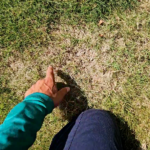
Bermuda under drought stress develops what Ken calls “tiger stripes” — green stripes running through areas of brown, creating a mottled look across the lawn. The tips will also take on a slight purple tinge. Importantly, even the green portions won’t look as vibrant as a well-watered Bermuda lawn — the whole area reads as uneven rather than uniformly healthy or uniformly brown.
Zoysia is the trickiest of the three. Like Bermuda, it develops a mottled green-and-brown pattern, but the tell-tale sign is different: the grass turns patchy, and the tips turn gray rather than purple.
St. Augustine is the easiest to diagnose, for two reasons. First, height: stand back and look across the lawn — stressed St. Augustine will sit visibly stunted, roughly an inch shorter than the healthy grass around it. Second, and more reliably, look at the leaf blade itself. St. Augustine blades have a seam running vertically down the center. In a healthy, well-watered area, that blade is open. In a drought-stressed area, the blade folds shut along that seam — closing like a butterfly closing its wings. That’s the grass telling you it’s thirsty, even if it isn’t dying yet.
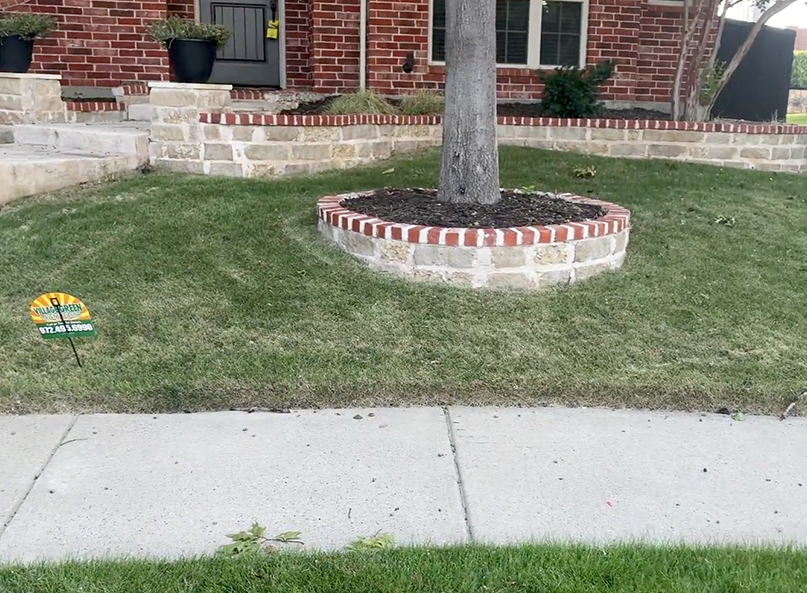
You’ll often see a ring pattern around trees — healthy grass close to the trunk under the drip line, transitioning to stressed grass as you move out into full sun. It looks like the shade is the problem. It’s the opposite: during drought, that shade is protecting the grass, not holding it back.
Parkways are usually the first place drought stress appears, and it’s a coverage issue, not a watering-schedule issue. Ken notes there’s no sprinkler head built to evenly cover a narrow, roughly 4-foot-wide strip — so once temperatures climb, parkways are typically the earliest and most visible sign that a lawn is under-watered.

We’re Already Watching for This
Drought stress doesn’t wait for a scheduled visit to show up, so Village Green doesn’t either. During the summer stretch — or whenever North Texas hits a dry, hot spell like the one we’re in now — our technicians flag drought stress on customer accounts in real time, right during a regular treatment visit. If a tech sees it, it goes into that customer’s post-visit summary, often with a photo. If something looks more serious — a bad case, or a pattern that suggests a sprinkler coverage gap rather than just dry weather — we’ll take a short video instead of just a photo.
On top of that, we run a dedicated drought stress report every week through the season. This week alone — after several weeks with no rain in most of our service area and temperatures near 100 degrees — nearly 20 customer accounts came back flagged. Customers with clear signs got an email notice. Anyone whose lawn showed more severe stress got a text, so it wouldn’t sit in an inbox unread while the lawn kept losing ground.
None of that happens because someone asked. It’s part of how we keep an eye on lawns between visits — not just treating what’s in front of us, but watching for what’s about to become a bigger problem.
If you’re recognizing any of these patterns, adjusting your watering schedule to match current conditions is the first step. Our Summer Watering Guide walks through timing and duration by grass type: https://qrco.de/bgt8pw
If you’re not sure what you’re looking at, we’re happy to take a look — call or text us at 972-495-6990.
Ken Hyatt is the owner of Village Green Lawn and Pest, serving North Texas homeowners with lawn care, mosquito control, and pest control since 1980.