
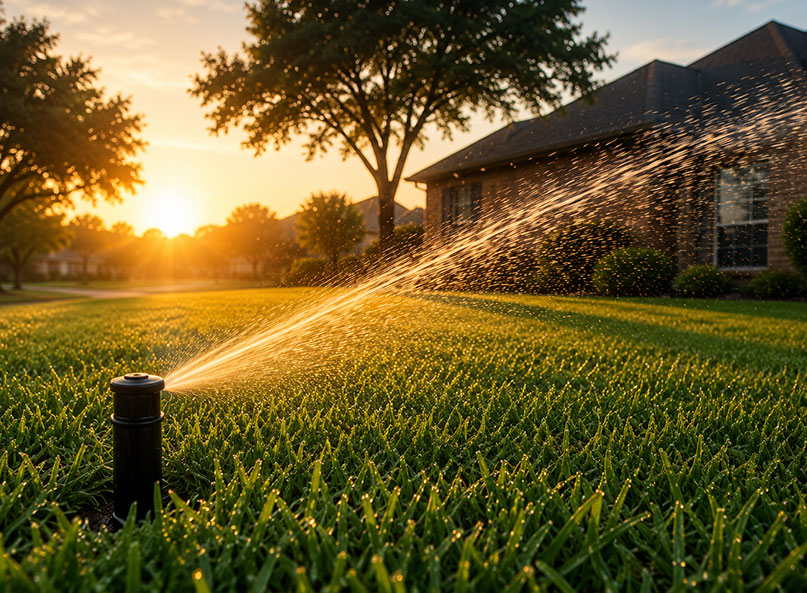
If you’re putting in the effort to maintain your North Texas lawn this summer, there’s one variable that matters more than fertilizer, more than weed control, and arguably more than anything else we do: water.
How you water from June through late September doesn’t just affect what your lawn looks like this summer — it determines how it comes out of dormancy next spring.
This guide covers exactly what your lawn needs, when to run it, how to adjust for your zone type, and what to watch for if things start going wrong.
How Much Water Does Your Lawn Actually Need?
The answer starts with understanding what your soil is losing. In full North Texas summer heat, your soil loses approximately one inch of water per week through evaporation and transpiration. Your irrigation system’s job is to replace that inch.
With standard spray heads, it takes about 60 minutes of run time to deliver one inch of water to a zone. That’s your baseline.
If you’re currently running 20 or 30 minutes per zone, you’re replacing roughly half of what’s being lost. The deficit compounds week over week — the soil gets progressively drier, roots pull back from the surface, and by August recovery is much harder.
Water Early. Water in Cycles.
The schedule that consistently works across North Texas lawns:
Why three cycles instead of one long run
North Texas clay soils absorb water slowly — about 10 minutes of spray before runoff begins. Running three shorter cycles with gaps between them gives the water time to soak in before the next cycle starts. You get deeper penetration, less runoff onto driveways and sidewalks, and stronger root development as roots follow water deeper into the soil.

Why early morning
The 2, 4, and 6 AM start times aren’t arbitrary. Watering at night risks fungal disease — blades stay wet too long. Watering midday wastes water to evaporation before it reaches roots. Early morning gives you the lowest evaporation rates, minimal wind drift, and enough time for blades to dry before temperatures climb.
Adjustments by zone type
Not every zone runs the same. Here’s how to adjust for what you have:
| Zone type | Run time per cycle | Weekly total |
| Standard spray heads (full sun) | 10 min × 3 cycles × 2 days | 60 min/week |
| Rotary head sprinklers | 15 min × 3 cycles × 2 days | 120 min/week |
| Shaded areas | 5 min × 3 cycles × 2 days | 30 min/week or less |
| Drip systems | 10 min daily | Monitor bed moisture |
Rotary heads: why double the time?
Rotary heads use the same volume of water as spray heads but cover roughly twice the area, so they deliver water more slowly per square foot. Doubling the run time (15 minutes per cycle instead of 10) delivers the equivalent coverage. If your system mixes spray and rotary zones, program them separately.
Shaded zones: less is more
Heavy shade areas receive significantly less direct sun and lose far less water to evaporation. Running shaded zones at full spray head times typically overwatered them, which can promote disease. Reduce by 50% or more and monitor for pooling or consistently wet soil.
Drip systems: daily is different
Drip systems deliver water differently than spray heads — 10 minutes daily is the general starting point, but output varies significantly by system, emitter type, and bed size. Monitor bed moisture directly rather than relying solely on run time.
Pro tip: Seasonal Adjust setting
Most modern controllers include a “Seasonal Adjust” or “Water Budget” feature. Program your summer schedule at 100%, then dial down to ~50% in spring and fall as temperatures drop. You can adjust the percentage without reprogramming each zone individually — a much faster way to transition between seasons.
How to spot drought stress before it becomes damage
Most lawn problems we diagnose in summer come back to water. Each grass type shows stress differently — knowing what to look for lets you catch it early, before the damage compounds.
St. Augustine grass
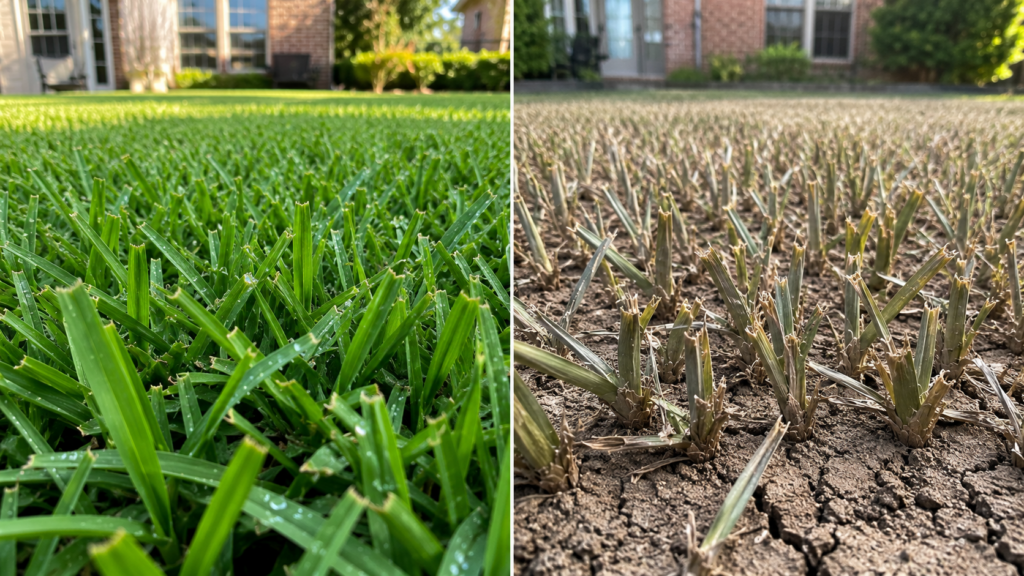
St. Augustine has a seam that runs the length of the back of the blade. A healthy, well-watered blade stays open and flat. When it’s not getting enough water, it folds along that seam — like a book closing.
A reliable field test: if you’re seeing blade fold in full-sun areas of your yard but the grass under your trees still looks flat and healthy, that’s your confirmation. It’s a watering issue, not a disease problem. The shaded grass is losing less water and staying hydrated; the full-sun areas are not.
| Important: St. Augustine and drought stress St. Augustine doesn’t recover from severe drought stress the way Bermuda and Zoysia can. Prolonged underwatering can kill it outright — not just thin it or brown it, but eliminate it entirely from affected areas. If you’re seeing blade fold in full-sun zones, correct your schedule immediately and don’t wait to see if it gets worse. |
Bermuda Grass
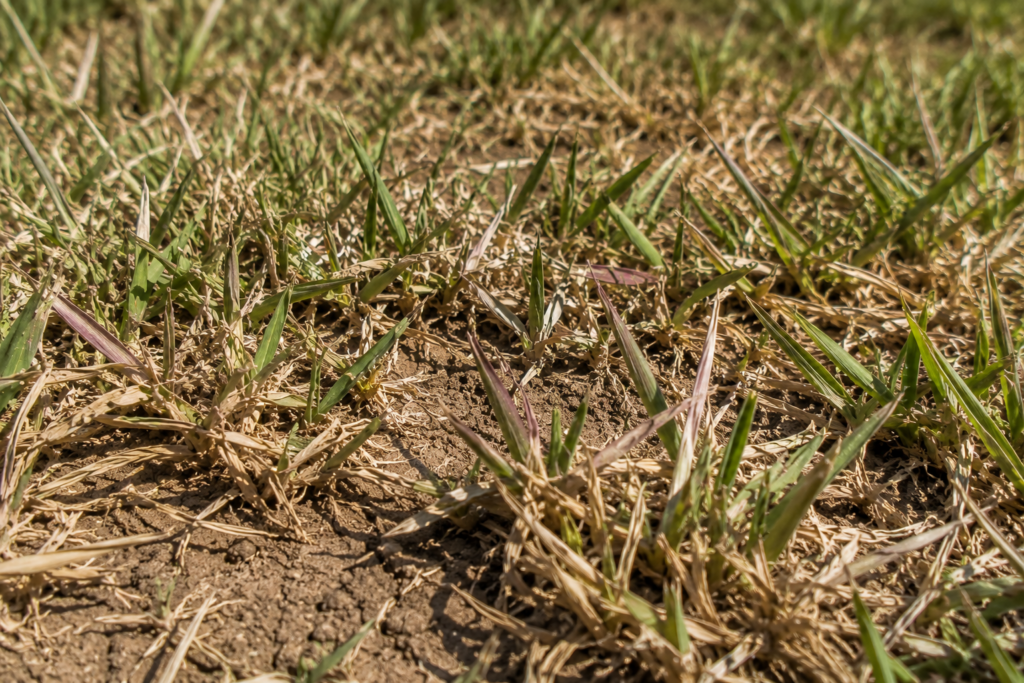
Bermuda grass leaves will take on a purplish hue before the classic mottled green-and-brown pattern sets in. The patchwork appearance — alternating patches of bright green and brown — is especially common in parkways and along street edges where sprinkler coverage is less even.
Left unaddressed, the brown expands as stress worsens. Bermuda is more resilient than St. Augustine and will recover once watering is corrected, but chronic underwatering heading into fall weakens it going into dormancy.
Zoysia
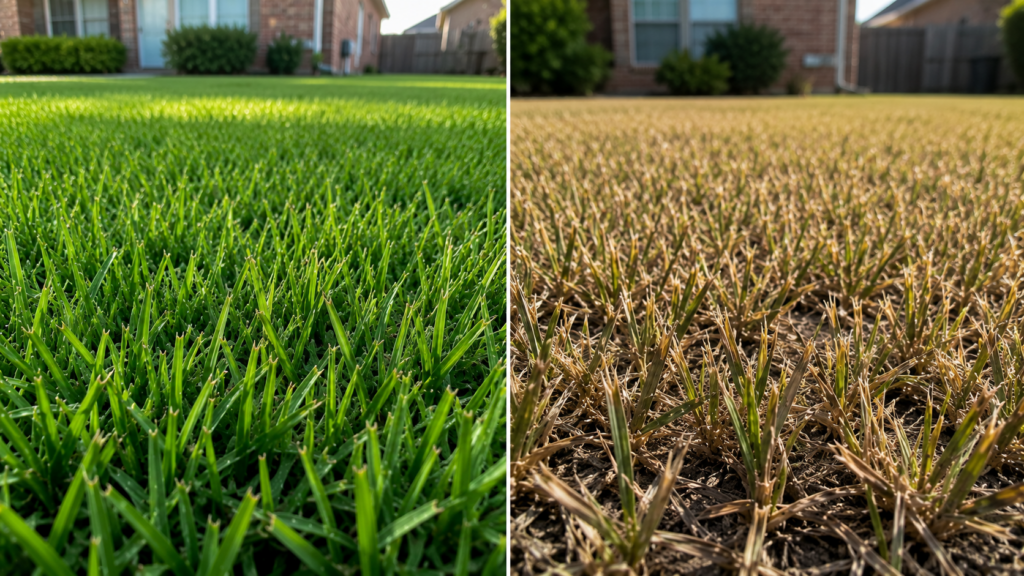
Watch for browning at the blade tips — that’s Zoysia’s first signal that it’s not getting enough water. Zoysia handles stress better than St. Augustine and will typically recover once watering is corrected, but prolonged stress weakens the root system heading into fall when it matters most.
If you’re seeing any of these signs, start by verifying your controller is running the schedule above, then walk each zone while it’s running to check for heads that aren’t rotating, aren’t popping up fully, or are spraying off-pattern. Most of the time the fix is a schedule or coverage adjustment, not a lawn treatment.
What Village Green Watches For On Every Visit
Every visit to your property includes a visual assessment of your lawn’s current condition — not just the treatment we’re there to perform. If we’re seeing signs of drought stress, we note it in your after-service communication. If we’re seeing significant stress that needs attention, we reach out directly.
This matters because the treatments we apply depend on your lawn being properly hydrated to be effective. Fertilizer and weed control applied to drought-stressed turf don’t perform the way they should. We have a direct interest in your watering schedule being right.
A few things we document on every visit:
- Current turf condition and any visible stress signs
- Sprinkler head issues observed during the visit
- Any coverage gaps or dry patches noted in the lawn
- Recommendations communicated in your after-service report
We’ve been doing this in North Texas since 1980. We know what summer does to lawns here, and we know what proper watering looks like by neighborhood, by soil condition, and by grass type. When we flag something, it’s worth a look.
Questions about your lawn this summer?
Text us a photo at 972-495-6990 and we’ll take a look. If it’s a watering issue we’ll tell you. If it’s something that needs a treatment, we’ll tell you that too.
You can also download the full 2026 Summer Watering Guide:
Download our free summer watering guide
or give us a call at 972-495-6990. We’re always glad to help.
If you’d like to get your lawn on a consistent program, we’re glad to talk through what that looks like for your yard. No contracts, 90-Day Worry-Free Guarantee.